

DRAUGHTPROOFING
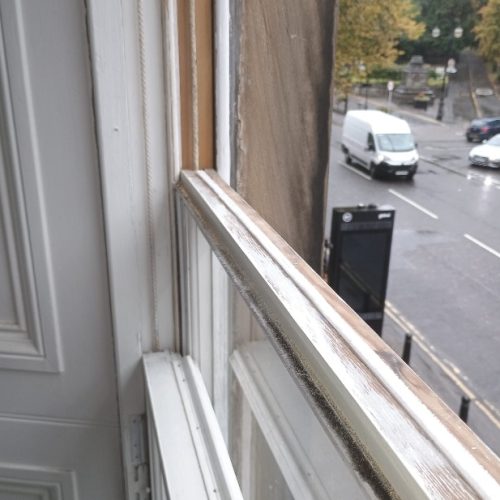
1. Dismantling and Initial Inspection
Typical draughtproofing in Scotland begins with the careful dismantling of the traditional sash and case window. A skilled joiner removes the timber staff beads and parting beads, allowing the heavy upper and lower sashes to be safely extracted from the box frame. This initial stage is crucial for a thorough inspection, where the specialist identifies any hidden timber decay or structural damage. By stripping the window to its components, they ensure the subsequent sealing work sits on a solid, healthy foundation.
2. Precision Routing and Seal Integration
Once the sashes are removed, grooves are precision-routed into the timber, specifically along the meeting rails and the bottom of the lower sash. These discreet channels house high-quality, long-lasting brush seals or “pile” strips. In Scotland’s temperamental climate, these flexible seals are vital; they bridge the uneven gaps caused by centuries of timber movement. Unlike rigid DIY solutions, these integrated seals allow the window to remain completely airtight when closed while still permitting the wood to breathe naturally across the seasons.
3. Mechanical Overhaul and Re-balancing
A comprehensive draughtproofing service almost always includes a mechanical overhaul of the pulley system. Old, frayed sash cords are replaced with durable, waxed cotton alternatives, and the original cast iron or lead weights are carefully re-balanced to the specific weight of the glass. This ensures the sashes glide effortlessly rather than sticking or slipping. Lubricating the pulley wheels further reduces friction, transforming a heavy, difficult window into one that operates with silent precision. This mechanical restoration is essential for daily usability.
4. Re-beading and Rattle Elimination
Reassembly involves installing new “carrier” staff and parting beads that feature built-in weather-stripping. These beads are carefully pinned into place, effectively sandwiching the sashes to eliminate the “rattle” that frequently plagues Scottish homes during winter gales. The meeting rail seal is a critical focal point, as this central junction is where the most significant heat loss typically occurs. By creating a continuous barrier around the entire perimeter, the system blocks wind ingress without altering the window’s historic, elegant profile or sightlines.
5. Thermal Performance and Heritage Preservation
The finished result provides a dramatic improvement in thermal efficiency, with some professional systems reducing air infiltration by over 80%. Beyond warmth, homeowners notice a significant reduction in external street noise and a cleaner interior due to less dust ingress. Most importantly for listed buildings in Scottish conservation areas, this work is entirely sympathetic. It preserves the original craftsmanship and aesthetic of the sash and case window while providing the modern comfort and energy savings expected in a contemporary home
EXCELLENTTrustindex verifies that the original source of the review is Google. Project organisation from start to finish was brilliant. Composite decking area was an awkward shape but Davy’s workmanship ensured a great looking finish to decking, steps and border sleepers. Weather has been truly terrible but Davy just kept going. Would highly recommend Hillhead.Posted onTrustindex verifies that the original source of the review is Google. The team did a great job! They arrived on time, were very tidy, friendly and polite. We are very pleased with the work they did - and there was no cleaning up to do when they left. What's not to like?Posted onTrustindex verifies that the original source of the review is Google. Alasdair and the team fitted 12 internal doors for us, which have totally transformed our home! I would highly recommend Hillhead Joiners, a really friendly and professional firm, who I would have no hesitation in using again. Many thanks guys! Margaret.Posted onTrustindex verifies that the original source of the review is Google. Excellent job. Quality materials and workmanshipPosted onTrustindex verifies that the original source of the review is Google. Hillhead Joiners removed our old wooden decking and the original framing, which they replaced with new framing and composite decking. The end result was first class. Very happy.Posted onTrustindex verifies that the original source of the review is Google. The team at Hillhead Joiners are fantastic and I wouldn’t hesitate to recommend. Every step of the way from surveying and quoting through to carrying out the work the communication has been fantastic and we genuinely couldn’t be happier with the finished result!Posted onTrustindex verifies that the original source of the review is Google. We were delighted with the service provided by Hillhead Joiners on our replacement balcony. The workmen arrived on time each day, they were pleasant and professional throughout and I felt they took ownership and a pride in the work through to completion. The communication from the work manager was helpful and prompt, as Alasdair always kept us in the loop with suppliers and updates. We were thrilled with the final product and also with the fact that the workmen cleaned up every day, and were respectful of our property as if it was their own. Perfect! Thanks boys.Posted onTrustindex verifies that the original source of the review is Google. I would like to thank Hillhead joiners for an outstanding composite decking and glass balustrade contract they completed yesterday .The standard of workmanship is to the highest level all completed by a wonderful skilled team . Thanks again Alasdair and staff truly outstanding 👍Posted onTrustindex verifies that the original source of the review is Google. Wonderful service from my first email to ask about changing my interior doors until they finished installation . Very polite smart and professional job with no mess to clear up afterwards.excellent communication between myself and the owner .No stress at all. I thoroughly recommend this company and will definitely use them again. So thank you Hillhead Joinery.Verified by TrustindexTrustindex verified badge is the Universal Symbol of Trust. Only the greatest companies can get the verified badge who has a review score above 4.5, based on customer reviews over the past 12 months. Read more